


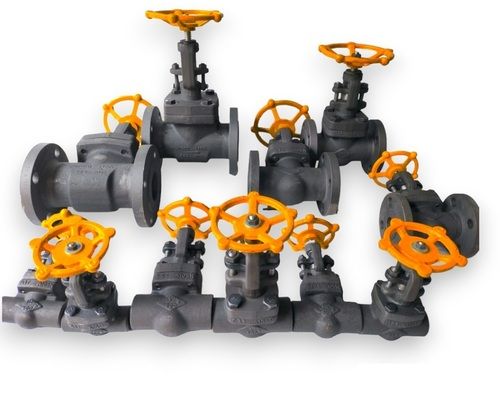
Forged Steel Globe Valve
2000 INR/Unit
Product Details:
- Caliber Standard
- Channels Single
- Pressure Class 150/300/600/800
- Connection Socket Weld, Screwed, Flanged
- Structure Globe Type
- Material Forged Steel
- Power Manual
- Click to View more
X
Forged Steel Globe Valve Price And Quantity
- 10 Piece
- 2000.00 - 20000.00 INR/Unit
- 2000 INR/Unit
- 13Cr/SS/Monel/Stellite
- API 598
- API 602, BS 5352
- DN15 to DN50
- Class VI
- A105, F304, F316
- Screwed (NPT/BSP), Socket Weld, Flanged
- Handwheel
- Bolted Bonnet
- Renewable/Integral
Forged Steel Globe Valve Product Specifications
- Rust Proof, Black Coating
- Class 150/300/600/800
- Globe Type
- Industrial, Chemical, Power Plants, Oil & Gas
- Forged Steel
- Socket Weld, Screwed, Flanged
- Water, Oil, Gas, Steam
- Standard
- ANSI/ASME B16.5
- 1/2 to 2
- Single
- Manual
- Up to 425C
- 13Cr/SS/Monel/Stellite
- API 598
- API 602, BS 5352
- DN15 to DN50
- Class VI
- A105, F304, F316
- Screwed (NPT/BSP), Socket Weld, Flanged
- Handwheel
- Bolted Bonnet
- Renewable/Integral
Product Description
A forged steel gate valve is a type of valve used to control the flow of liquids or gases in a pipeline. These valves are known for their durability, strength, and reliability, making them suitable for high-pressure and high-temperature applications. The term "forged steel" refers to the manufacturing process where steel is shaped under high pressure to increase its structural integrity.
| Designs Features | ||
| 1 | MOC | ASTM A105/ ASTM A182 Gr. F304/F316 |
| 2 | Size | 15mm to 50mm (1/2" TO 2") |
| 3 | End Connection | Flanged End (ASME B16.5) / Secrewed End / Socket Weld End / Butt Weld End |
| 4 | Pressure Class | 150#/300#/600#/800#/1500#/2500# |
| 5 | Design & manufacturing Standard | API 602 / ISO 15761 / ASME B16.34 |
| 6 | Testing & Inspection | API 598 |
| 7 | Valve Bore | Reduce Bore / Full Bore |
| 8 | Face to Face | Manufacturing Std. |
| 9 | Temp. Range | -29C to 425C |
| Key Features | ||
| Locking, Stem Extension, Nippple Extension on Request | ||
| Leak Proof Body-Bonnet Joint With Spiral Wound Gasket | ||
| Technical Specifications | ||
| Sr.No. | Description | Material |
| 1 | Body | ASTM A105 |
| 2 | Plug | ASTM A217 Gr CA15 |
| 3 | Stem | ASTM A182 Gr F6a |
| 4 | Gasket | SS 316 Spiral Wounded Graphite |
| 5 | Bonnet | ASTM A105 |
| 6 | Hex Bolt | ASTM A193 Gr B7 |
| 7 | Gland Packing | Flexible Graphite Rings |
| 8 | Gland Bush | ASTM A276 Type SS410 |
| 9 | Stud | ASTM A193 Gr B7 |
| 10 | Gland Flange | ASTM A105 |
| 11 | Stud Nut | ASTM A194 Gr 2H |
| 12 | Yoke Sleeve | BS970 : 1955 EN1A |
| 13 | Hand Wheel | ASTM A105 |
| 14 | Stem Nut | ASTM A194 Gr 2H |
| Testing Parameters-800# | ||
| Test Type | Unit- Kg/Cm2 | |
| Hydro. Shell | 208 | |
| Hydro. Seat | 153 | |
| Air/Pneumatic | 7 | |
Versatile Performance Across Media
This forged steel globe valve is compatible with water, oil, gas, and steam, making it a versatile choice for diverse industrial applications. Designed to operate efficiently at pressures up to Class 800 and temperatures up to 425C, it ensures optimal performance and longevity in the most demanding environments.
Customization for Seamless Integration
Available in multiple body materials (A105, F304, F316), bonnet types, end connections (screwed, socket weld, flanged), and trim options (13Cr, SS, Monel, Stellite), this globe valve easily fits custom pipeline requirements. The wide size range (DN15-DN50) and precise port sizes (1/2"-2") allow engineers flexibility for new projects or retrofits.
FAQ's of Forged Steel Globe Valve:
Q: How is the forged steel globe valve operated?
A: The valve operates manually through a handwheel, allowing for precise throttling or complete shut-off of the flow. This manual operation provides dependable control without the need for external power sources.Q: What are the main benefits of using forged steel globe valves with bolted bonnets?
A: Bolted bonnet designs offer secure sealing and easier access for maintenance or repairs. Forged steel construction ensures enhanced strength, leak resistance, and longevity, making the valve suitable for high-pressure and high-temperature environments.Q: When should I choose a renewable seat over an integral seat in this valve?
A: A renewable seat is ideal when frequent maintenance or seat replacement is anticipated, as it allows for easier and more cost-effective servicing. Integral seats suit applications where extended seat longevity is more critical, and minimal maintenance is required.Q: Where can these forged steel globe valves be installed?
A: These valves are widely used in industrial settings such as chemical plants, oil & gas facilities, power plants, and other applications where reliable flow control for fluids and gases is essential.Q: What design and testing standards do these valves comply with?
A: They are designed and manufactured according to API 602 and BS 5352, and are tested as per API 598 standards. This ensures consistent quality, safety, and performance in critical service conditions.Q: How does the valve's finish enhance its performance?
A: The rust-proof black coating protects the valve from corrosion and environmental wear, extending its operational life even in harsh industrial conditions.Tell us about your requirement

Price:
Quantity
Select Unit
- 50
- 100
- 200
- 250
- 500
- 1000+
Additional detail
Mobile number
Email


X2 VALVES PRIVATE LIMITED
GST : 24AAACX4564F1ZE
Contact Details

- Survey No.980/1, B/h Rangani Engineering, Captain Gate, Shapar (veraval), Rajkot - 360024, Gujarat, India
- Phone : 08071931331

- Mr Sagar Donga (Marketing Manager)
- Mobile : 08071931331
- Send Inquiry
 Send Inquiry
 Send Inquiry
 Send SMS
X2 VALVES PRIVATE LIMITED
All Rights Reserved.(Terms of Use)
Developed and Managed by Infocom Network Private Limited.
Developed and Managed by Infocom Network Private Limited.

