


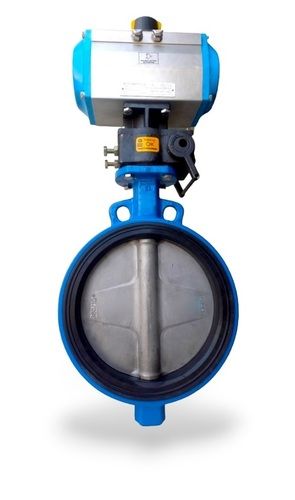
Pneumatic Operated Butterfly Valve
10000 INR/Unit
Product Details:
- Connection Wafer / Lug / Flanged
- Valve Type Pneumatic Operated Butterfly Valve
- Material Stainless Steel / Cast Iron / Ductile Iron / PVC
- Power Source Pneumatic
- Pressure PN10/PN16/Class 150 (upto 16 bar)
- Media Water, Air, Oil, Gas, Chemicals
- Working Temperature -20C to +120C (depends on material)
- Click to View more
X
Pneumatic Operated Butterfly Valve Price And Quantity
- 10000 INR/Unit
- 10 Unit
Pneumatic Operated Butterfly Valve Product Specifications
- Water, Air, Oil, Gas, Chemicals
- Stainless Steel / Cast Iron / Ductile Iron / PVC
- PN10/PN16/Class 150 (upto 16 bar)
- DN50 to DN600 (2 to 24)
- Wafer / Lug / Flanged
- Pneumatic Operated Butterfly Valve
- Round/Disc
- Pneumatic
- -20C to +120C (depends on material)
Product Description
X2CDBFV model Butterfly valve incorporates the optimum design features to provide long trouble free service in the field. This general purpose soft seated Butterfly valve has a fully rubber lined single piece body with a centric disc construction and is available in wafer type body paten. The body liner which also functions as the soft seat, comes in either a replaceable version or an integrally moulded (bonded) version and offers -100 % bi-directional sealing against full vacuum to rated pressures of PN10 or PN16. The wafer style body has universal design to fit between pipe flanges of almost all popular flange standards.
| Designs Features | ||
| 1 | MOC | CI/WCB/CF8/CF8M - (CF3/CF3M And high nickel Alloys on Request) |
| 2 | Valve Design | Concentric Design |
| 3 | Size | 40mm to 600mm (10" TO 24") |
| 4 | End Connection | Wafer End |
| 5 | Pressure Class | PN10/PN16 |
| 6 | Operation | Single Acting Or Double Acting Actuator |
| 7 | Design & manufacturing Standard | BS EN 593 / ISO 5211 |
| 8 | Testing & Inspection | API 598 |
| 9 | Face to Face | BS EN 558 |
| Key Features | ||
| Self lubricated PTFE bearings for both drive end and non-drive end shaft ensures minimum bearing friction torque. | ||
| Seat liner extending on to the flange contact faces, eliminates the need for separate flange gaskets during installation. | ||
| Bi-directional valve with tight shut-off sealing capability to hold vacuum to rated pressure in either direction | ||
| Suitability for ON/OFF as well as throttling duties. | ||
| Choice of seat and disc materials to suit media conditions and service requirements. | ||
| Excellent adaptability for actuated operation through standardized top flange mounting dimensions for actuator fitment. | ||
| Technical Specifications | ||
| Sr.No. | Description | Material |
| 1 | Body | Cast Iron/Ductile Iron/S.G.Iron/WCB/CF8/CF8M- (CF3-CF3M On Request) |
| 2 | Disc | S.G.Iron/WCB/CF8/CF8M- (CF3-CF3M On Request) |
| 3 | Seat | EPDM/Nitrile/Neoprene/Viton/Silicon |
| 4 | Stem | SS304/SS316/SS410 |
| 5 | O-Ring | Rubber |
| 6 | Bush | PTFE |
| 7 | Washer | SS304 |
| 8 | Circlip | Spring Steel |
| 9 | Actuator | Standard |
| Testing Parameters-PN10 | ||
| Test Type | Unit-Bar | Unit-PSIG |
| Hydro. Shell | 15 | 220 |
| Hydro. Seat | 11 | 160 |
| Air/Pneumatic | 7 | 80 |
| Testing Parameters-PN16 | ||
| Test Type | Unit-Bar | Unit-PSIG |
| Hydro. Shell | 24 | 340 |
| Hydro. Seat | 16 | 230 |
| Air/Pneumatic | 7 | 80 |
Exceptional Corrosion Resistance and Bubble-Tight Shutoff
This butterfly valve boasts a highly durable epoxy-coated body for CI or DI, along with stainless steel, aluminum bronze, or PVC discs, ensuring robust corrosion resistance. The bubble-tight Class VI seal guarantees bi-directional shutoff security, making it suitable for demanding process applications where leakage prevention is critical.
Automated Remote Control & Flexible Position Indication
The pneumatic actuator, available as double acting or spring return, allows for precise, automatic control of fluid flow. For monitoring, the valve supports mechanical, visual, or optional feedback switch position indicators, making it ideal for both remote and local operation in industrial automation setups.
Versatile Design for Broad Application Spectrum
Customizable torque, multiple seat materials (EPDM, NBR, PTFE, Viton), and standardized end connections (ANSI, DIN, JIS, BS) make this valve adaptable to a wide range of fluids and operating conditions. It is a reliable choice for water, air, oil, gas, and chemical systems in manufacturing, processing, and utility sectors.
FAQ's of Pneumatic Operated Butterfly Valve:
Q: How does a pneumatic operated butterfly valve with double acting or spring return actuator function?
A: This valve uses compressed air to activate an actuator, which rotates the disc for opening or closing the flow path. Double acting actuators require air for both open and close cycles, whereas spring return actuators use air for one action and a spring for the reverse, ensuring fail-safe operation if air supply is lost.Q: What seat materials are available and how do I choose between EPDM, NBR, PTFE, and Viton?
A: EPDM is excellent for water and weak acids, NBR is preferred for oils and hydrocarbons, PTFE suits high chemical resistance and temperature, and Viton is ideal for aggressive chemicals and higher temperatures. Choosing the right seat material depends on the media type and working temperature of your application.Q: When should I select bubble-tight bi-directional sealing for my process?
A: Bubble-tight bi-directional sealing (Class VI) is crucial when you need absolute leak-free performance in both directions, especially for hazardous, costly, or environmentally sensitive media. It prevents leakage under both low and high pressures, ensuring a safe and efficient system.Q: Where are epoxy-coated butterfly valves typically installed for optimal corrosion resistance?
A: Epoxy-coated valves are best installed in water treatment plants, chemical processing units, and environments prone to moisture or corrosive substances. This coating protects cast iron or ductile iron bodies from rust, extending the valve's operational life in harsh settings.Q: What is the process for customizing torque requirements for different valve sizes and applications?
A: Torque specifications are determined by valve size, operating pressure, and fluid media. Manufacturers adjust actuator selections and accessories to meet the required torque, ensuring reliable opening and closing. It is crucial to consult the supplier with your application details to get optimal performance.Q: How is remote or automatic operation achieved and what are the benefits?
A: Remote or automatic operation is enabled by pneumatic actuators integrated with accessories such as solenoid valves, limit switches, and air filter regulators. These allow the valve to respond to external control signals, providing faster response, reduced manual intervention, and better integration in automated systems.Q: What are the main benefits of using a pneumatic operated butterfly valve with standardized end connections (ANSI, DIN, JIS, BS)?
A: Standardized end connections ensure easy, compatible installation with global piping systems, simplify replacement, and reduce downtime. This flexibility enhances system reliability and allows for efficient maintenance and future upgrades.Tell us about your requirement

Price:
Quantity
Select Unit
- 50
- 100
- 200
- 250
- 500
- 1000+
Additional detail
Mobile number
Email

Other Products in 'Butterfly Valve' category


X2 VALVES PRIVATE LIMITED
GST : 24AAACX4564F1ZE
Contact Details

- Survey No.980/1, B/h Rangani Engineering, Captain Gate, Shapar (veraval), Rajkot - 360024, Gujarat, India
- Phone : 08071931331

- Mr Sagar Donga (Marketing Manager)
- Mobile : 08071931331
- Send Inquiry
 Send Inquiry
 Send Inquiry
 Send SMS
X2 VALVES PRIVATE LIMITED
All Rights Reserved.(Terms of Use)
Developed and Managed by Infocom Network Private Limited.
Developed and Managed by Infocom Network Private Limited.

